
Walk into any pharmacy in any country in the world and there is a near-certain chance you will find CeraVe on the shelf. And among CeraVe’s extensive product lineup, the Foaming Cleanser is consistently the brand’s bestselling product in the oily and combination skin category.
The question is whether it deserves that status. Because a cleanser is not just a cleanser, it is the foundation of every skincare routine. Get it wrong and nothing else in your routine works properly. Your serums cannot absorb through dirty skin. Your moisturizer cannot repair a barrier that is being stripped twice daily. Your SPF cannot protect skin that is chronically inflamed from an irritating formula.
Get it right — and everything else becomes more effective.
This complete CeraVe Foaming Cleanser review covers the formula, the ingredients, the correct application, who it works for, who it does not work for, and how it compares to the competition. By the end you will know definitively whether this is the cleanser your routine needs.
What Is CeraVe Foaming Cleanser?
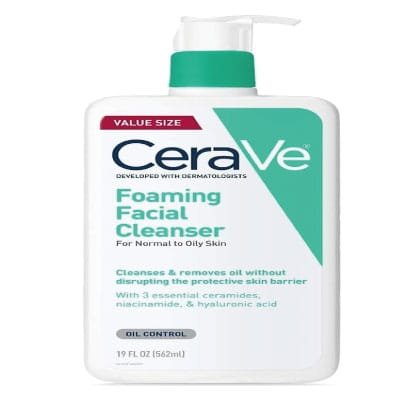
CeraVe Foaming Facial Cleanser is a gel-to-foam cleanser formulated for normal to oily skin. It is part of CeraVe’s dermatologist-developed lineup; the brand was co-developed with dermatologists from its founding in 2005 and remains one of the most consistently recommended drugstore skincare brands by dermatologists globally.
The Foaming Cleanser is specifically designed to
Remove excess sebum effectively without stripping the skin barrier
Maintain the skin’s natural pH at a barrier-safe level
Deliver ceramides, hyaluronic acid, and niacinamide alongside cleansing
Be non-comedogenic and fragrance-free for oily and acne-prone skin
Available sizes:
236ml (8oz) — standard
473ml (16oz) — value size
562ml — large refill size
473ml eco-recharge refill pouch
CeraVe Foaming Cleanser Ingredients — The Complete Breakdown
The ingredient list is what separates CeraVe Foaming Cleanser from most competing cleansers at its price point. Most drugstore foaming cleansers are simply surfactant systems with preservatives — nothing more. CeraVe includes three clinically active ingredients in the formula itself.
Active Ingredients
Niacinamide (Vitamin B₃) Niacinamide is the addition in the newer formula that elevates this cleanser above standard foaming cleansers. Even as a rinse-off product, niacinamide at the concentrations used in CeraVe provides measurable anti-inflammatory benefits and contributes to sebum regulation throughout the 60-second contact time. The cumulative daily effect of niacinamide in a cleanser — twice daily, 365 days per year — is more significant than most people realize.
Ceramides (1, 3, and 6-II) Three essential ceramides—the same combination found throughout CeraVe’s moisturizer lineup—are present in the Foaming Cleanser formula. This is CeraVe’s defining brand ingredient. Ceramides are the lipid molecules that make up 50% of the skin barrier. Including them in a cleanser is genuinely meaningful for oily skin—which, despite appearing to have plenty of barrier function, is often paradoxically barrier-compromised because of the harsh cleansers typically used on it.
Hyaluronic Acid Hyaluronic acid in a rinse-off cleanser provides brief but cumulative hydration throughout the cleansing process—preventing the extreme moisture loss that harsh foaming cleansers cause. The result is a cleanser that removes excess oil without leaving the tight, dry, uncomfortable sensation that most foaming cleansers produce.
The Surfactant System
The cleansing is performed by a surfactant system of sodium lauroyl lactylate and behentrimonium chloride — significantly milder than the sodium lauryl sulfate (SLS) found in most competing foaming cleansers. SLS is the surfactant responsible for the stripped, tight, squeaky-clean feeling that damages the skin barrier. CeraVe Foaming Cleanser avoids SLS entirely—delivering effective cleansing without the barrier disruption.
pH
The CeraVe Foaming Cleanser pH falls between 5.5 and 6.5—within the acceptable range for barrier-safe cleansing (ideal is 4.5 to 5.5, but 5.5 to 6.5 is considerably better than most foaming cleansers, which reach pH 7 to 9).
Full Ingredient Assessment
Fragrance-free: Yes ✅ Non-comedogenic: Yes ✅ Alcohol-free: Yes ✅ Dermatologist tested: Yes ✅ Safe for pregnancy: Yes ✅
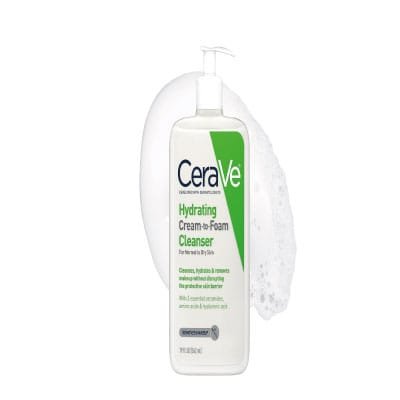
CeraVe Foaming Cleanser vs. Hydrating Cleanser — Which Should You Choose?
This is the most common question about the CeraVe cleanser lineup, and the answer depends entirely on your skin type.
The simple rule:
Oily, combination, acne-prone skin → CeraVe Foaming Cleanser
Dry, sensitive, eczema-prone skin → CeraVe Hydrating Cleanser
CeraVe Foaming Cleanser Review — Texture and Sensory Experience
Packaging
The CeraVe Foaming Cleanser comes in a pump bottle — the most hygienic and most practical format for a daily-use cleanser. The pump dispenses a consistent amount of product without requiring you to touch the formula directly. The green cap version (normal to oily skin) is the standard formula.
Texture in Hand
The formula comes out of the pump as a thick, clear gel. It does not foam in the hand — only when it contacts water and is massaged onto the skin. The gel texture makes it easy to dispense the right amount without waste.
On the Skin
When massaged onto wet skin, the CeraVe Foaming Cleanser transforms from a clear gel to a medium-density foam—not the thick, dramatic lather of SLS-based cleansers but a comfortable, effective foam that distributes easily across the face.
Why it sometimes does not foam well: The CeraVe Foaming Cleanser requires adequate water to foam properly. Applied to a barely wet face, it will feel more like a gel cleanser. Wet your face thoroughly—then apply and massage for the full lather to develop.
After Rinsing
This is where CeraVe Foaming Cleanser distinguishes itself from almost every competitor in its category. After rinsing, the skin feels
Clean — genuinely free of excess oil and impurities ✅
Comfortable — not tight or dry ✅
Balanced — not stripped or raw ✅
Ready for the next step — not requiring immediate moisturizer application to be comfortable ✅
The difference between this post-cleanse feeling and the tight, dry, stripped feeling of most foaming cleansers is the ceramide and hyaluronic acid inclusion — and it is genuinely noticeable from the first use.
CeraVe Foaming Cleanser — How to Use Correctly
Step-by-Step Application
- Wet your face with lukewarm water — not hot. Hot water disrupts the acid mantle and removes more natural oil than necessary even before the cleanser touches the skin.
- Dispense 1 to 2 pumps into your palm. One pump is sufficient for most people—two for those with heavier makeup or SPF to remove.
- Rub hands together briefly to begin the gel-to-foam transformation.
- Apply to face using gentle circular motions—upward on the cheeks, downward on the forehead, and circular on the nose and T-zone.
- Massage for 60 seconds — this is the minimum time for surfactants to dissolve oil-based impurities and SPF effectively. Most people massage for 10 to 15 seconds—insufficient for effective cleansing.
- Rinse thoroughly with lukewarm water — remove all traces of cleanser. Cleanser residue causes irritation and blocks subsequent product absorption.
- Pat dry with a clean towel — never rub. Rubbing causes friction damage to the barrier that cleansing should be supporting.
- Apply the rest of your routine immediately—toner, serum, and moisturizer—within 60 seconds of cleansing while skin is still slightly damp.
How Many Times a Day?
Twice daily — morning and night. Once in the morning, it removes overnight sebum and pillow bacteria. Once at night, remove the day’s SPF, pollution, and sebum accumulation. Using it more than twice daily strips the barrier without providing additional cleansing benefit.
CeraVe Foaming Cleanser with Tretinoin
For tretinoin users, CeraVe Foaming Cleanser is one of the most recommended cleansers specifically because the ceramide content supports the barrier function that tretinoin temporarily disrupts. Use it morning and night during tretinoin adjustment. The non-irritating formula does not add to the retinoid adjustment period the way harsher cleansers do
Who Is CeraVe Foaming Cleanser Best For?
CeraVe Foaming Cleanser for Oily Skin
The primary use case and the skin type for which this cleanser performs best. The combination of effective oil removal and barrier-supporting ceramides addresses the central paradox of oily skin cleansing—removing excess sebum without triggering the rebound oil production that harsh stripping cleansers cause.
For oily skin—twice daily CeraVe Foaming Cleanser use consistently produces the following:
A cleaner-feeling skin throughout the day
Less rebound oiliness compared to harsh foaming cleansers
Better product absorption because skin is genuinely clean rather than barrier-compromised
No increased sensitivity or reactivity
CeraVe Foaming Cleanser for Acne-Prone Skin
Acne-prone skin needs a cleanser that removes pore-clogging sebum and dead cell accumulation without further damaging the already-compromised barrier that allows bacterial invasion. CeraVe Foaming Cleanser addresses both requirements simultaneously.
The non-comedogenic formula will not contribute to new comedone formation. The mild surfactant system removes existing pore congestion without the barrier damage that ironically worsens acne over time. And the ceramide content provides active barrier support that helps prevent the bacterial access that initiates inflammatory acne.
For the best results with acne-prone skin, use CeraVe Foaming Cleanser as part of a complete routine: Morning: CeraVe Foaming Cleanser → Niacinamide serum → Oil-free moisturizer → Non-comedogenic SPF 50 Night: CeraVe Foaming Cleanser → BHA toner (3 nights) or adapalene (2 nights) → CeraVe PM Lotion
CeraVe Foaming Cleanser for Combination Skin
Combination skin—oily T-zone with normal or dry cheeks—benefits from the CeraVe Foaming Cleanser because it is gentle enough not to over-dry the dry zones while effective enough to address the oily T-zone.
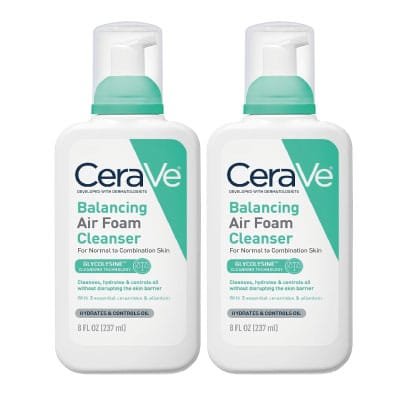
For very dry cheeks on combination skin, consider using the Foaming Cleanser only on the T-zone and water only on the dry cheek areas. Or alternate between Foaming and Hydrating Cleansers (Foaming in the morning, Hydrating at night) for a zone-appropriate approach.
CeraVe Foaming Cleanser for Sensitive Skin
Generally well-tolerated by most sensitive skin types. The fragrance-free, SLS-free, non-comedogenic formula avoids the most common cleanser irritants. For sensitive skin that is also oily or acne-prone, this is likely the gentlest effective option in the oily skin cleanser category.
For sensitive skin that is primarily dry—use CeraVe Hydrating Cleanser instead.
CeraVe Foaming Cleanser for Dry Skin
Not recommended for dry skin as a regular daily cleanser. The foaming formula — even with ceramides — removes more natural oil than dry skin can afford to lose. For dry skin, CeraVe Hydrating Cleanser is the correct choice. The Foaming Cleanser can be used occasionally by dry skin types for double cleansing after heavy SPF or makeup, followed immediately by a rich ceramide moisturizer.
CeraVe Foaming Cleanser vs Competitors
CeraVe Foaming Cleanser vs La Roche-Posay Effaclar Gel
| Feature | CeraVe Foaming | La Roche-Posay Effaclar |
|---|---|---|
| Ceramides | ✅ Yes | ❌ No |
| Niacinamide | ✅ Yes | ✅ Yes (zinc pidolate) |
| Hyaluronic acid | ✅ Yes | ❌ No |
| pH | 5.5 to 6.5 | 5.5 |
| Salicylic acid | ❌ No | ✅ Yes |
| Price | $ | $$ |
| Best for | Oily skin barrier repair | Oily acne-prone skin clearing |
Verdict: CeraVe wins for barrier support and value. La Roche-Posay Effaclar wins if you want a salicylic acid cleanser for active acne clearing.
CeraVe Foaming Cleanser vs Cetaphil Oily Skin Cleanser
| Feature | CeraVe Foaming | Cetaphil Oily Skin |
|---|---|---|
| Ceramides | ✅ Yes | ❌ No |
| Niacinamide | ✅ Yes | ❌ No |
| Hyaluronic acid | ✅ Yes | ❌ No |
| Active ingredients | More advanced | Basic formula |
| Price | $ | $ |
Verdict: CeraVe wins clearly — more advanced formula at the same price. Cetaphil is only preferred for very reactive sensitive skin that needs absolute minimal ingredients.
CeraVe Foaming Cleanser vs CeraVe SA Cleanser
| Feature | CeraVe Foaming | CeraVe SA Cleanser |
|---|---|---|
| Salicylic acid | ❌ No | ✅ 2% |
| Ceramides | ✅ Yes | ✅ Yes |
| Best for | Daily gentle cleansing oily skin | Active pore clearing and acne |
| Irritation risk | Lower | Slightly higher |
Verdict: Use CeraVe Foaming Cleanser for daily gentle cleansing. Use CeraVe SA Cleanser if you specifically need salicylic acid cleansing — though a leave-on BHA toner is more effective for pore clearing than a rinse-off salicylic cleanser.
Best Morning Routine with CeraVe Foaming Cleanser
| Step | Product | Why |
|---|---|---|
| 1 | CeraVe Foaming Cleanser | Remove overnight oil |
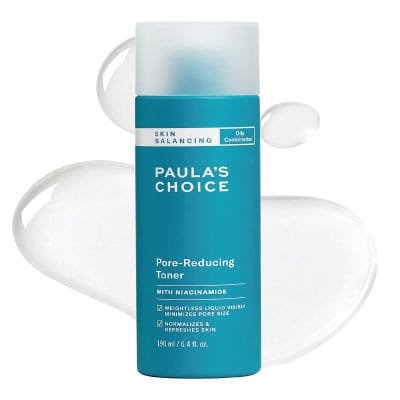
| 2 | Niacinamide toner or BHA toner | Oil control from step one |
| 3 | Niacinamide 10% serum | Sebum regulation |
| 4 | Vitamin C serum | Brightening and protection |
| 5 | Oil-free gel moisturizer | Lightweight hydration |
| 6 | Non-comedogenic SPF 50 | Always final step |
Best Night Routine with CeraVe Foaming Cleanser
| Step | Product | Why |
|---|---|---|
| 1 | Oil cleanser | Remove SPF and makeup |
| 2 | CeraVe Foaming Cleanser | Second cleanse |
| 3 | BHA toner or adapalene | Treatment |
| 4 | Niacinamide serum | Oil control |
| 5 | CeraVe PM Facial Moisturizing Lotion | Seal and repair |
CeraVe Foaming Cleanser Causing Breakouts — Why and How to Fix
A surprisingly common complaint—and almost always explainable by one of four causes:
Cause 1—Purging: If you recently started using actives (retinol, AHA, BHA) alongside the cleanser, breakouts may be purging—not a cleanser reaction. True purging resolves within 4 to 6 weeks.
Cause 2 — Not rinsing thoroughly: Cleanser residue left on skin causes breakouts. Rinse for a full 30 seconds after the foam disappears.
Cause 3 — Individual reaction to an inactive ingredient: Behentrimonium chloride — a conditioning ingredient — occasionally causes reactions in acne-prone skin. If breakouts are new and in new areas, discontinue and try CeraVe Hydrating Cleanser instead.
Cause 4—Over-cleansing: Using the Foaming Cleanser more than twice daily strips the barrier, triggers rebound oil production, and causes breakouts. Twice daily maximum. 🛒 CeraVe Foaming Facial Cleanser 473ml — Best value size for daily oily skin us
Is CeraVe Foaming Cleanser good for oily skin?
Yes—it is one of the best cleansers for oily skin available at any price point. The combination of effective oil removal through a mild surfactant system, barrier support from three essential ceramides, and oil regulation from niacinamide makes it significantly more beneficial for oily skin than standard foaming cleansers. It removes excess sebum without triggering the rebound oil production that harsh cleansers cause. 🛒 CeraVe Foaming Facial Cleanser 236ml — Best starter size for first-time users.
CeraVe Foaming Cleanser or Hydrating Cleanser—which is better?
For oily, combination, and acne-prone skin—Foaming Cleanser. For dry, sensitive, and eczema-prone skin—Hydrating Cleanser. Both are excellent products designed for different skin types. The foaming cleanser removes more oil, which is beneficial for oily skin and harmful for dry skin. The Hydrating Cleanser removes impurities gently without disrupting the natural oils that dry skin needs.
How long does it take for CeraVe Foaming Cleanser to work?
The clean, comfortable feel after cleansing is immediate from the first use. The sebum-regulating effects of the niacinamide accumulate over 4 to 6 weeks of consistent twice-daily use. Visible improvements in pore appearance and overall skin clarity typically appear at 6 to 8 weeks of consistent use as part of a complete skincare routine. 🛒 CeraVe Foaming Cleanser with Niacinamide — Latest formula with added niacinamide for enhanced oil control.
Is CeraVe Foaming Cleanser safe for pregnancy?
Yes, CeraVe Foaming Cleanser is considered safe during pregnancy. It does not contain retinoids, salicylic acid, or chemical UV filters—the most common pregnancy skincare concerns. The ceramides, niacinamide, and hyaluronic acid are all pregnancy-safe ingredients. Always confirm with your OB-GYN for personalized guidance.
Does CeraVe Foaming Cleanser have salicylic acid?
The standard CeraVe Foaming Facial Cleanser does not contain salicylic acid. CeraVe does offer separate products—the CeraVe Acne Control Cleanser and CeraVe SA Cleanser—which contain salicylic acid for more active pore clearing. If you specifically need BHA cleansing for blackheads and congestion, consider those formulas alongside the foaming cleanser—or use the foaming cleanser for daily use and a leave-on BHA toner for more effective pore treatment.
Can I use CeraVe Foaming Cleanser twice a day?
Yes — twice daily is the recommended frequency. Morning cleansing removes overnight sebum and bacteria. Night cleansing removes the day’s accumulated SPF, pollution, and sebum. Do not use them more than twice daily—over-cleansing strips the barrier and causes rebound oiliness.
Final Thoughts — Does CeraVe Foaming Cleanser Deserve Its Status?
CeraVe Foaming Facial Cleanser has achieved its position as one of the most consistently recommended cleansers in the world through a simple formula: it does its job better than most competing products, it costs less, and it is available everywhere.
The mild surfactant system removes oil effectively without stripping. The ceramides support the barrier that overcleansing typically destroys. The niacinamide provides active sebum regulation that accumulates over time. The hyaluronic acid maintains hydration through the cleansing process. And the fragrance-free, non-comedogenic formula does all of this without irritating the oily and acne-prone skin it is designed for.